


Want more piano teaching blog posts? Click here to check out my Piano Method Navigator blog!
In this post, we will talk about who Edvard Grieg was, what he composed, the Lyric Pieces as a whole, Op. 12 as a set, Arietta specifically, and pedagogical strategies for effectively teaching Arietta. At the end of this post, an accompanying embedded Youtube video will provide a summary and demonstration of several of these teaching strategies.
Overview: Op. 12 No. 1 “Arietta”
Piece length: ~1.5 minutes
Piece difficulty: Early Intermediate – Intermediate
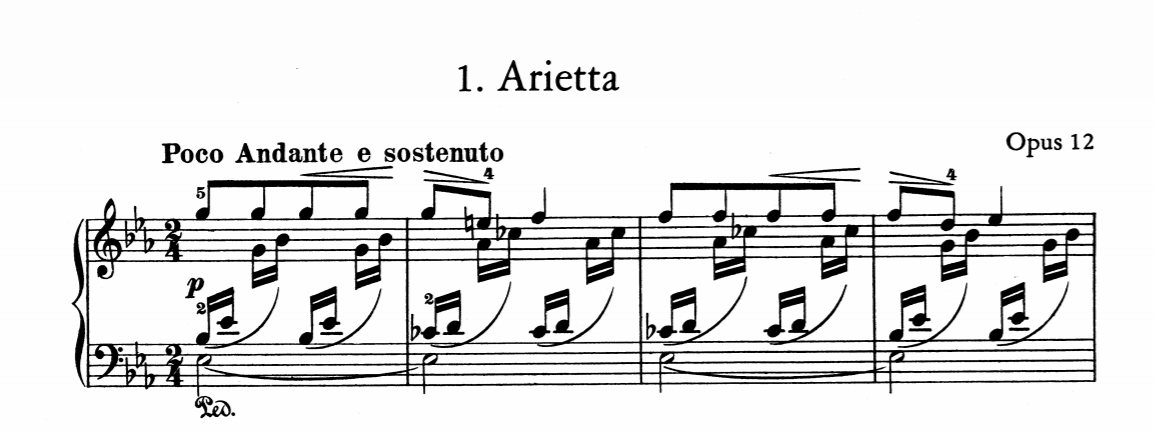
Defining characteristics: Dream-like three-voice texture– floating soprano melody, warm bass, harp-like arpeggiation in the middle voice
Pedagogical challenges: Arpeggiation spread between two hands, keeping tabs on all three voices, consistent bass line, singing the melody with fingers four and five in the right hand
Recommended edition: Edition Peters — Grieg Lyric Pieces Book 1 Op. 12 — $12.95
Recommended recordings: Emil Gilels or Sviatoslav Richter (YouTube recordings linked)
Who was Edvard Grieg?


Edvard Grieg was a Norwegian composer, conductor, and pianist who lived during the second half of the 19th century.[1] During his lifetime, he heavily promoted Norwegian music, making himself the biggest proponent of Scandinavian music in his lifetime.[2] He is known for the incorporation of nationalism in his music, having been heavily influenced by fellow countryman Rikard Nordraak, another Norwegian composer.[3] He expertly and effortlessly combined folksongs and the Romantic style in his pieces, which made his music extremely popular. Grieg held the company of great story-tellers of his day, such as Hans Christian Andersen.[4] His attention to story details makes his music iconic for its ability to capture moods and characters.
What are the Lyric Pieces?


Some of Grieg’s most famous works are his lyric pieces. The first sets were written as songs for voice, with piano sets coming later. Grieg wrote these lyric pieces with amateurs in mind, which made them accessible and, by extension, well-loved by the public. Because of their mindfulness of the intermediate musician along with their beautiful use of melody and harmony, they have remained an important part of the pedagogical repertoire.
There are sixty-six lyric pieces for the piano, which Grieg wrote between 1867 and 1901, a period of thirty-four years.[5] Grieg placed these sixty-six pieces in ten opus numbers, each opus containing six to eight selections.[6] The lyric pieces represent some of Grieg’s most iconic original writing and focus heavily on creating scenes and characters, without including unessential technical complications.[7] This accessibility of writing is not due to an early, undeveloped composer. Rather, as Grieg aged and matured, he wrote more and more of these small piano pieces.[8] Jee Young Choi in her dissertation, “Edvard Grieg’s Lyric Pieces: An Analysis of His Musical Style” made the observation that though Grieg’s lyric pieces were short, they showed an “advanced brand of harmony that influenced many composers in the early twentieth century.”[9] Grieg wrote these pieces with cleverness and skill, while still maintaining an approachable level for beginning to intermediate pianists. Not only that, according to Finn Benestad in his book, Edvard Grieg, the Man and the Artist, the Lyric Pieces offer “melodic charm,” “rhythmic and harmonic freshness,” and “national flavor” that make them intrinsically appealing to music lovers of all levels.[10] It is because of these likeable qualities that the lyric pieces were highly responsible for Grieg’s popularity in Norwegian homes, as well as homes around the world.[11]
The beauty of these small pieces exceeds merely a strict pedagogical application. Though Grieg himself wrote in a letter to a Danish composer and friend—Niels Ravnkilde—that the pieces were “easy” and “for piano students,” even great pianists have enjoyed the breadth of musical sensitivity held within them.[12] Emil Gilels recorded a selection of Grieg’s Lyric Pieces, including this Op. 12, and of them he said he “discovered a whole new world of intimate feeling.”[13] Harold Schonberg claimed the Lyric Pieces were as “good as some of Mendelssohn’s Songs Without Words and better than most of them.”[14] Truly, these pieces offer great depths of musicality to be explored, for both students and masters alike.

What’s so special about Op. 12?
Though he had been writing lyric pieces for voice for quite some time, Lyric Pieces Op. 12 was the first set of lyric pieces Grieg wrote exclusively for the piano, as well as the shortest.[15] In fact, the eight pieces in Op. 12 all clock in under three minutes in length, which is probably why the original title for this set was “Lyrical Short Pieces.”[16]
Grieg published this set of pieces in Copenhagen in December of 1867.[17] By this time, he was heavily influenced by nationalism, and several of the pieces in this set—no. 5, 6, and 8—reflect this quite obviously. Op. 12 No. 8, Faedrelandssang, even had Norwegian patriotic lyrics set to it at a later time by Bjørnstjerne Bjørnson, a prominent Norwegian writer.[18] In fact, the piece is best known in Norway as a song for male choir set with these lyrics.[19] In addition, one can trace influences from other composers such as Schumann and Chopin in Grieg’s Op. 12.[20] Op. 12. No. 3 The Watchman’s Song, was even written in response to a performance of Shakespeare’s Macbeth.[21] Every piece in Op. 12 has a clear character, inspiration, or idea.[22] Overall, the pieces in Op. 12 are “sweet and beautiful, but wonderfully light and coolly refreshing,” as described by Einear Steen-Nøkleberg.[23]
Why teach Op. 12 No. 1, Arietta?

Arietta from Op. 12 is a lovely, delicate piece with a most likeable character. It consists of twenty-three measures organized in a tiny ABA’ form. With three independent voices, the texture is defined by a warm bass line, a harp-like, arpeggiated middle figure, and a floating soprano.[24] This combination is often noted as being Schumannesque, but the style of arpeggiation can be seen in many other composers, such as Bach and Chopin.[25] Perhaps the most similar writing texture is in Mendelssohn’s Song Without Words Op. 19. No. 1. Though there is no definite evidence, it is likely that Grieg was influenced and inspired by this work.[26]
The character of this piece lends itself well to developing a singing tone and being conscious of multiple layers of texture at the same time. The needed consciousness of texture includes noting variation in both dynamics and articulation amongst voices.[27] For instance, Grieg offers small crescendo and decrescendo markings above the melody, but presumes the accompanying voices to remain piano.[28] In terms of articulation, the soprano and arpeggiated voices are both slurred, but across different beams. While creating the character of a “beautiful dream,” this piece is ripe with opportunities for technical and musical advancement.[29]
What is difficult about Arietta and what are ways to effectively teach it?
Though this is considered one of the easier Lyric Pieces, there are a few things teachers should watch out for when working on this piece with a student.
Perhaps the most obvious is balance. With three voices working together to create a character, it is important to intentionally assess each voice. Practicing them alone and in differing combination (bass with soprano, soprano with arpeggiation, etc.) can help the student hear nuances by taking away distractions. Practicing the bass line with only the soprano will reveal Grieg’s simple, but clever counterpoint.[30] The bass line should be consistent, but not too loud. The soprano line should float effortlessly atop both the other voices. The arpeggiation should be the softest voice and executed evenly—a difficult feat as it is spread between the two hands. Often student have difficulty playing patterns evenly between two hands because their ears have not experienced an even sound of that pattern. To combat this, have the student play the arpeggiation in just the left hand, noting the way it sounds to group the notes in one. This will also help with freedom of touch. Combine this with the right hand playing the melody to enhance the aural picture.
Teachers should also be mindful of the fingerings required to play this piece. Because the arpeggiation is split between the two hands, unnecessary accents on the thumbs should be carefully watched. The goal is evenness of tone in the arpeggiations, and the thumbs will likely want to get in the way. In addition, the melody is played frequently by fingers four and five, the weakest fingers, so extra attention to creating a “bell-like” singing tone might be needed.[31] Making sure the hand is shifted with the weight primarily fixed on the upper fingers may be helpful, as well as maintaining a flexible and moving wrist throughout. One way students can practice the independence of voices while encouraging a rich, singing tone on the top is to have them play the sixteenth notes staccato while holding the eighth note on the top.
Another possible challenge is pedaling. Greig does not supply the performer with detailed pedaling, instead, he offers pedaling notes at key points and assumes the performer to fill in the rest. A recommended tactic for instructing students in the interim is pedaling every two measures (this is approximate as it depends primarily on chord changes), perhaps with shallow changes in between to avoid unattractive blurring.
Possible sequence of teaching:
- Have student play soprano line alone with appropriate articulation, dynamics, and phrasing (developing clear aural picture of melody before other voices distract)
- Instruct student to play soprano with bass (building aural picture of harmonic structure and counterpoint, reveal if bass notes are being held the proper amount of time)
- Have student play soprano with middle arpeggiation in blocked chords, no bass (continuing to build aural picture of harmonic structure)
- Allow students to try playing arpeggiation with left hand and melody with right hand, no bass (to help student hear arpeggiation as one figure and differentiate between arpeggio notes and melody notes)
- Suggest the student listen to individual voices when they add all three together (first listen to soprano, then play again and listen to bass, then play and listen to middle voice)
YouTube demonstration:

A delightful piece, Arietta is worth the time and enjoyment of both teacher and student. Choi said it beautifully: “Arietta aims at simplicity rather than complexity, freshness rather than sophistication, naiveté rather than passion, while maintaining its own color, shape, a strong character and beauty.”[32]
References:
[1] John Horton and Nils Grinde, Grieg, Edvard (Oxford University Press, 2001), http:////www.oxfordmusiconline.com/grovemusic/view/10.1093/gmo/9781561592630.001.0001/omo-9781561592630-e-0000011757.
[2] Horton and Grinde.
[3] Audun Kayser, Edvard Grieg in Words and Music (Bergen: Verbum, 1992).
[4] Kayser.
[5] SYLVIA RUTH REYNOLDS, “The ‘Lyric Pieces’ of Edvard Grieg” (D.M.A., University of Kansas, 1979), http://search.proquest.com/pqdtglobal/docview/302928519/30AD321CA88C4754PQ/1.
[6] Horton and Grinde, Grieg, Edvard; Gerald Abraham, Grieg: A Symposium, 1st American ed. (Norman: University of Oklahoma Press, 1950).
[7] REYNOLDS, “The ‘Lyric Pieces’ of Edvard Grieg”; Einar Steen-Nøkleberg, Onstage with Grieg: Interpreting His Piano Music (Bloomington: Indiana University Press, 1997).
[8] Jee Young Choi, “Edvard Grieg’s Lyric Pieces: An Analysis of His Musical Style” (D.M.A., Boston University, 1998), http://search.proquest.com/pqdtglobal/docview/304434007/abstract/B53B306734104175PQ/1.
[9] Choi, 17.
[10] Finn Benestad and Dag Schjelderup-Ebbe, Edvard Grieg: The Man and the Artist (Lincoln: University of Nebraska Press, 1988).
[11] Benestad and Schjelderup-Ebbe.
[12] Edvard Grieg, Finn Benestad, and William H. Halverson, Letters to Colleagues and Friends (Columbus: Peer Gynt Press, 2000).
[13] Bryce Morrison, Gilels, Emil (Oxford University Press, 2001), http:////www.oxfordmusiconline.com/grovemusic/view/10.1093/gmo/9781561592630.001.0001/omo-9781561592630-e-0000011135.
[14] Harold C Schonberg, The Lives of Great Composers (London: Futura Publications, 1975).
[15] Horton and Grinde, Grieg, Edvard; Steen-Nøkleberg, Onstage with Grieg.
[16] REYNOLDS, “The ‘Lyric Pieces’ of Edvard Grieg.”
[17] Benestad and Schjelderup-Ebbe, Edvard Grieg.
[18] Horton and Grinde, Grieg, Edvard.
[19] David Monrad Johansen and Madge Robertson, Edvard Grieg (Princeton, New York: Princeton university press; American-Scandinavian foundation, 1938).
[20] Johansen and Robertson.
[21] Johansen and Robertson.
[22] REYNOLDS, “The ‘Lyric Pieces’ of Edvard Grieg.”
[23] Steen-Nøkleberg, Onstage with Grieg.
[24] Steen-Nøkleberg.
[25] Steen-Nøkleberg; Choi, “Edvard Grieg’s Lyric Pieces.”
[26] Choi, “Edvard Grieg’s Lyric Pieces.”
[27] REYNOLDS, “The ‘Lyric Pieces’ of Edvard Grieg.”
[28] Choi, “Edvard Grieg’s Lyric Pieces.”
[29] Steen-Nøkleberg, Onstage with Grieg.
[30] Choi, “Edvard Grieg’s Lyric Pieces.”
[31] Choi.
[32] Choi.
3 responses to “Teaching Singing Tone and 3-Voice Texture: “Arietta” from Edvard Grieg’s Lyric Pieces Op. 12”
Nice job at providing strategies to learn the piece! Particularly, playing the arpeggiated accompaniment with the left hand alone, while playing the melody in the right hand.
I really found the tables “Overview” at the beginning, and “Possible Sequence of Teaching” both clear and constructive! Also, in the first two paragraphs of “What are the Lyric Pieces?” – you describe Grieg and his musical style in a very engaging way. It made me want to listen to more of his music! After that, though, as well as in the video I felt the background information took a bit too long. It was helpful you included times throughout the video – that way, I could easily skip to what I wanted to learn.
Hi Anna Beth,
I really like the way you start with the “Overview” table which provides a clear information and good recommended recordings about this piece. I also like the way you used question as headings, it makes me want to keep reading the post. Your post is very organized.Only one little thing: the size of the words you chose in the post were a bit hard to read for me.
As far as the video, you might think about slowing down your speaking speed, but overall I do enjoy your YouTube demonstration, I can feel your energy and enthusiasm. Good job!